Conditions and allocations
Finovio Users Guide / Bank Reconciliation / Reconciliation Rules
A rule has two halves: what it matches against, and what it does once matched.
In this guide
Conditions
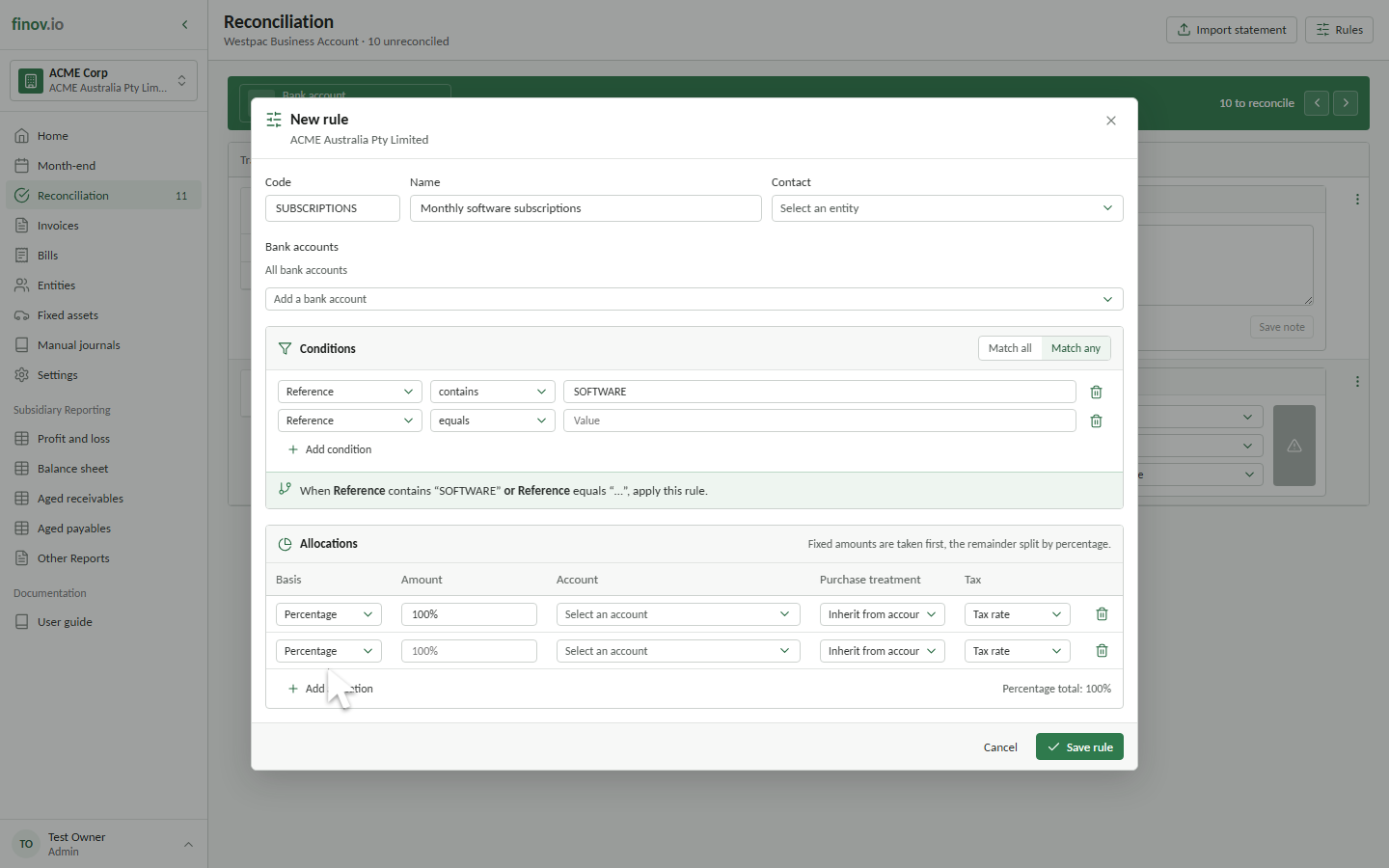
Each condition tests a field on the incoming transaction, typically its reference, details, or particulars, against a comparator such as contains or is empty. Every condition needs a value unless it uses the "is empty" comparator. A rule can have multiple conditions; how they combine is controlled by the rule's matching basis.
Allocations
Each allocation defines where matched funds post: an account, a tax code, and an amount expressed either as a percentage of the transaction or a fixed value. A rule can have multiple allocations, letting a single recurring transaction (like a monthly bundled charge) split across more than one account automatically. Allocations can also carry dimension tags, so recurring transactions get consistently coded for reporting without manual tagging every time.
Matching basis
The rule's basis determines whether it requires all its conditions to match or any of them. Set this deliberately, since a loosely matched rule can start pre-filling the wrong transactions.