Resource overview
API Documentation / Resources
The first public API release provides the endpoint families below. These are the proposed v1 paths that the implementation will target.
| Resource family | Reference | Primary scope |
|---|---|---|
| Authorized context | Connections and subsidiaries | accounting:read |
| Chart and reference data | Accounts and settings | accounting:read |
| Customers and suppliers | Contacts | contacts:read |
| Sales invoices, bills, and credit notes | Invoices | invoices:read |
| Posted and manual journals | Journals | accounting:read, manualjournals:read |
| Analysis categories | Dimensions | dimensions:read |
| Asset register | Fixed assets | fixedassets:read |
| Financial statements and drill-down | Reports | reports:read |
| Bank accounts and feed transactions | Bank data | accounting:read |
| Payroll records and settings | Payroll | payroll:read |
All paths in the table are relative to https://api.finov.io/v1. Resource names use lowercase plural nouns and kebab-case path segments.
Initial release boundary
The initial contract supports read access across the principal accounting records and payroll, plus controlled writes for standing data, contacts, invoices, manual journals, fixed assets, and API-sourced bank batches. Payroll is always read-only. Bank reconciliation mutations, company-group administration, users, roles, month-end workflows, rulesets, and application management are not part of v1.
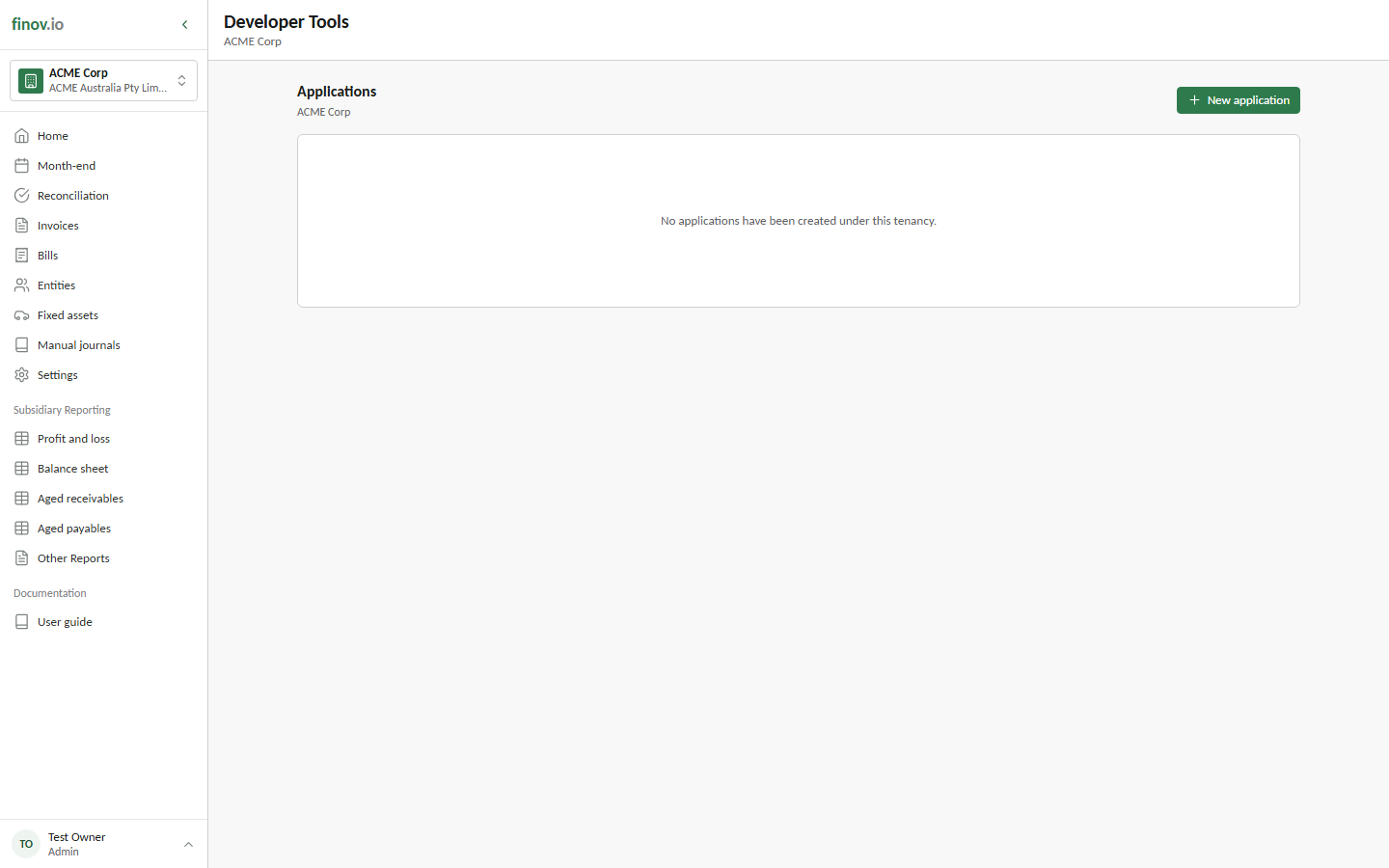
Application registration and grant management remain Finovio portal workflows. OAuth endpoints provide authorization and token operations, not general management access.
Endpoint design checklist
Each endpoint implementation must satisfy its resource page and define:
- Required scope and supported HTTP methods.
- Path, query, and request-body fields.
- Complete success representations and status codes.
- Validation, state-transition, and accounting rules.
- Pagination, filtering, and ordering behavior.
- Resource-specific error types.
- At least one request and response example.
Detailed request and response schemas remain to be agreed. The paths, methods, scopes, and lifecycle boundaries on these pages establish the endpoint surface for that schema work.